Finding energy rebates in Australia shouldn’t require hours of research across government websites. Our free energy rebate finder shows you every federal, state, and local rebate you qualify for in just 30 seconds—then connects you with verified installers who can apply those rebates immediately, reducing your upfront costs by thousands.
Australian governments offer substantial rebates for solar panels, heat pumps, air conditioning, and energy-efficient upgrades, but billions of dollars go unclaimed every year simply because households can’t navigate the complex system. We built the Compare Your Rates rebate finder to solve this problem.
Whether you’re considering solar panels, upgrading to a heat pump, installing energy-efficient air conditioning, or making other home improvements, discovering your rebate eligibility is now as simple as entering your postcode.
The Hidden Problem Costing Australian Households Thousands
Australia’s energy rebate system is incredibly generous but frustratingly complex. Between federal incentives, state programmes, and local council initiatives, homeowners can access rebates worth $2,000 to $5,000 or more for energy upgrades. Victorian households switching from gas to electric heating can save between $999 and $2,215 annually, with installation rebates further reducing upfront costs by thousands.
Despite these substantial savings, most Australians never claim the rebates they’re entitled to. The reasons are straightforward: eligibility criteria vary between programmes, rebate values change regularly, combining multiple rebates requires expert knowledge, application processes differ by state, and many people don’t know which rebates exist.
The result? Households either abandon energy upgrade plans entirely because they seem unaffordable, or they pay full price for installations without realising rebates could have cut costs in half.
How Our Energy Rebate Finder Works
We designed our rebate finder to eliminate every barrier between Australian households and the savings they deserve. The process is remarkably simple.
Step 1: Enter Your Postcode
Your location determines which rebates you can access. Federal programmes are available nationwide, but state and local incentives vary significantly. By starting with your postcode, we instantly filter thousands of programmes down to only those available in your area.
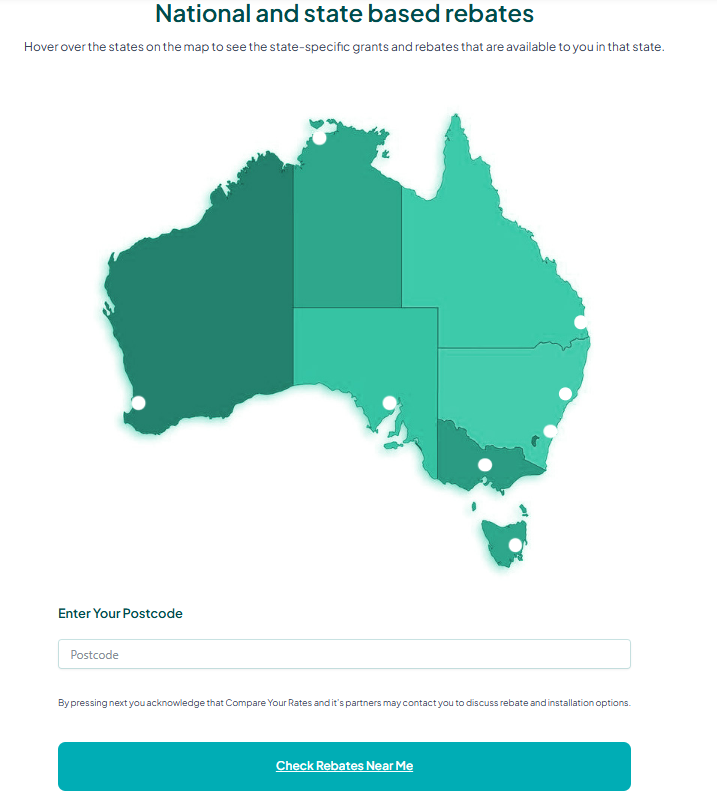
This geographical filtering saves hours of research and ensures you never waste time investigating rebates you’re not eligible for.
Step 2: Answer Quick Questions
A few simple questions help us understand your situation. We ask about your property type (house, apartment, rental, or owned), your planned upgrades (solar, heat pump, insulation, etc.), your household circumstances (concession card holder, first home buyer, etc.), and your current energy setup.
These questions take less than 30 seconds to answer but allow us to show you personalised results including rebates specifically for renters, additional incentives for concession card holders, special programmes for specific property types, and opportunities to combine multiple rebates.
Step 3: See Your Rebate Results
Within seconds, you’ll see a comprehensive breakdown of every rebate you qualify for, complete with rebate values in actual dollar amounts, eligibility requirements clearly explained, application processes and deadlines, and which rebates can be combined.
Our database updates continuously as governments announce new programmes or adjust existing ones, so you’re always seeing current information.
Step 4: Connect with Verified Installers
Finding rebates is only half the solution. Actually claiming them is where most people get stuck. That’s why we’ve built a network of verified installers who specialise in rebate applications.
These professionals understand which programmes can be combined, what documentation is required, how to process applications quickly, and most importantly, how to apply rebates at point of sale.
Instead of paying full price upfront and waiting months for rebate reimbursement, many of our installers can deduct rebates immediately. If your solar installation costs $8,000 but you qualify for $3,000 in rebates, you pay $5,000 at installation—the installer handles the rebate paperwork and receives the rebate directly from the government.
This transforms energy upgrades from requiring thousands in savings to being immediately affordable for most households.
What Energy Rebates Can You Find?
Our rebate finder searches across all available Australian energy programmes in several key categories.
Solar Panel and Battery Storage Rebates
Solar remains one of the most heavily subsidised energy upgrades in Australia. Available rebates include Small-scale Technology Certificates (STCs) that reduce installation costs by $2,000 to $4,000 depending on system size and location, state-based solar rebates offering additional $1,000 to $3,000 in many regions, battery storage incentives providing $2,000 to $4,000 for home battery systems, and interest-free loans up to $15,000 in some states for solar and battery installations.
A typical 6.6kW solar system might cost $7,000 to $9,000 before rebates but only $4,000 to $6,000 after federal and state incentives are applied.
Heat Pump and Hot Water System Rebates
Heat pumps represent some of the highest-value rebates currently available. Victorian households can access up to $1,000 through the Solar Homes Programme, plus up to $700 through the Victorian Energy Upgrade Scheme. From July 2025, an additional $400 rebate is available for Australian-made heat pumps.
NSW offers discounts ranging from $400 to $670 when replacing electric systems and $190 to $310 when replacing gas systems through the Energy Savings Scheme. South Australia provides up to $847 plus GST for homeowners disconnecting from gas under the Retailer Energy Productivity Scheme.
The Australian Capital Territory offers $1,250 off a new heat pump plus a $250 electricity bill credit with ActewAGL, and up to $2,500 off for eligible concession card holders. Tasmania provides interest-free loans up to $10,000 through the Energy Saver Loan Scheme.
Energy-Efficient Air Conditioning Rebates
Replacing old, inefficient air conditioners with modern reverse-cycle systems qualifies for rebates in most states. The Victorian Energy Upgrades programme offers discounts when upgrading to high-efficiency systems. NSW provides incentives through the Energy Savings Scheme for installing energy-efficient air conditioning. South Australia’s REPS programme includes rebates for efficient cooling upgrades.
These rebates typically range from $400 to $1,000 depending on system capacity and efficiency ratings.
Insulation and Weatherproofing Rebates
Proper insulation reduces heating and cooling costs year-round, making it eligible for various incentive programmes. Victorian households can access ceiling insulation rebates through the VEU programme. Low-income households in multiple states qualify for free or heavily subsidised insulation. Some councils offer additional rebates for insulation upgrades.
EV Charger Installation Rebates
As electric vehicle adoption grows, home charging infrastructure rebates are increasingly available. Several states offer rebates of $500 to $1,500 for installing home EV chargers. Some programmes include electrical upgrades required for charger installation. Rebates often apply to both owned homes and rental properties with landlord approval.
Commercial and Business Energy Upgrade Rebates
Businesses can access substantially larger rebates than residential customers. Commercial solar installations can receive rebates of $10,000 to $100,000+ depending on system size. Energy efficiency upgrades for businesses qualify for accelerated depreciation and immediate write-offs. Large-scale equipment upgrades receive substantial incentives through state energy efficiency schemes.
Real Savings: State-by-State Breakdown
Rebate availability and values vary significantly by state. Here’s what’s currently available across Australia.
Victorian Energy Rebates
Victoria leads Australia in energy rebate programmes. The Solar Homes Programme provides rebates for solar panels ($1,400), solar batteries ($3,000), and solar hot water ($1,000). The Victorian Energy Upgrades (VEU) programme offers significant discounts on heat pumps, air conditioning, insulation, and more. Additional rebates are available for low-income households and concession card holders.
A Victorian household installing solar panels, a battery, and a heat pump could access over $5,000 in combined rebates.
NSW Energy Rebates
New South Wales operates the Energy Savings Scheme (ESS), which provides point-of-sale discounts on energy-efficient appliances, heating and cooling systems, lighting upgrades, and hot water systems. The Low Income Household Rebate offers $285 annually for eligible households. Additional rebates are available through the Gas Rebate ($110 annually) and Family Energy Rebate programmes.
Queensland Solar and Energy Rebates
Queensland offers rebates for solar and battery installations in regional and remote areas, interest-free loans for solar and battery storage, and the Affordable Energy Plan providing up to $1,072 annually for eligible households. The Queensland Government is expanding rebate programmes with new initiatives announced regularly.
South Australian Energy Rebates
South Australia’s Retailer Energy Productivity Scheme (REPS) provides rebates for solar installations, energy-efficient appliances, heat pumps and hot water upgrades, and gas disconnection incentives. Additional concessions are available for pensioners and low-income households.
ACT Energy Rebates
The Australian Capital Territory offers some of Australia’s most generous rebates, including up to $2,500 for heat pump upgrades for concession card holders, $825 for ceiling insulation, and $5,000 interest-free loans through the Sustainable Household Scheme. The ACT also provides $250 electricity bill credits when upgrading to heat pumps.
Tasmanian Energy Rebates
Tasmania provides interest-free loans up to $10,000 for solar panels, heat pumps, batteries, and insulation through the Energy Saver Loan Scheme. The state also offers annual energy concessions for eligible households.
Western Australian and Northern Territory Rebates
While WA and NT have fewer rebate programmes than eastern states, they still offer incentives for solar installations, energy efficiency upgrades for low-income households, and various concession schemes. Programmes vary by region and eligibility.
Why Our Energy Rebate Finder Stands Out
Several features make our rebate finder uniquely valuable for Australian households.
Comprehensive Database Coverage
We track every available energy rebate programme across Australia, including federal Small-scale Technology Certificates, all state-based solar and energy efficiency programmes, local council initiatives and additional rebates, and time-limited promotional programmes and pilot schemes. Our database updates continuously, so you always see current information.
Verified Installer Network
Finding rebates is worthless without trustworthy installers to apply them. Every installer in our network is licensed and accredited for the work they perform, experienced with rebate applications and processes, able to apply rebates at point of sale in most cases, and rated and reviewed by previous customers.
We verify credentials, check references, and ensure installers maintain the required accreditations for rebate programmes.
Point-of-Sale Rebate Application
This is the feature that transforms affordability. Instead of the traditional process where you pay full price upfront, submit paperwork, and wait months for rebate reimbursement, our installers handle rebate applications and receive payment directly from government programmes.
You pay only the after-rebate price at installation. This means a $6,000 heat pump installation with $2,500 in rebates costs you $3,500 at the time of installation—no waiting, no complicated paperwork, no months of hoping your rebate application is approved.
Rebate Stacking Expertise
Many households qualify for multiple rebates simultaneously, but combining them requires expertise. Our system identifies all possible rebate combinations and our installers know how to stack federal STCs with state rebates, combine energy efficiency schemes with appliance-specific programmes, and layer low-income rebates on top of standard incentives.
In some cases, eligible households can access $5,000 to $8,000 in combined rebates for comprehensive energy upgrades.
Real Examples: Savings That Matter
Understanding abstract rebate values is one thing. Seeing real-world savings is another.
Example 1: Victorian Family Switching from Gas Heating
A family in Melbourne with ducted gas heating and no air conditioning uses our rebate finder and discovers they qualify for Victorian Energy Upgrades discounts on reverse-cycle split systems totalling approximately $1,200, potential Solar Homes rebate if adding solar panels of $1,400, and combined installation can save them $969 to $1,927 annually on energy bills.
Total upfront rebates: $2,600. They pay $3,400 instead of $6,000 for three reverse-cycle split systems. Based on annual energy savings of $1,400, the payback period is under three years, after which they’re saving $1,400 every year indefinitely.
Example 2: NSW Homeowner Adding Solar and Battery
A homeowner in Sydney uses the rebate finder and qualifies for federal STCs reducing solar cost by approximately $2,800, NSW Energy Savings Scheme discount on battery storage of $1,200, and potential low-interest financing through clean energy finance programmes.
Total rebates: $4,000 on a $12,000 solar and battery system. Out-of-pocket cost: $8,000. With annual savings of $1,500 on electricity bills, the system pays for itself in 5.3 years.
Example 3: Queensland Renter Installing Heat Pump
A renter in Brisbane discovers they qualify for Energy Savings Scheme discounts on heat pump hot water, even as a renter with landlord approval. The rebate reduces the $3,500 heat pump cost to $2,700 (landlord pays). Annual hot water energy savings: $400 to $600. The landlord recovers their $2,700 investment in 4.5 to 6.5 years through reduced energy costs, while the tenant enjoys lower bills immediately.
Example 4: ACT Concession Card Holder
A pensioner in Canberra uses the rebate finder and qualifies for the maximum $2,500 heat pump rebate for concession card holders, plus the $250 electricity bill credit. A $4,000 heat pump installation costs them only $1,250 out of pocket, with annual energy savings of $800 to $1,000.
The investment pays for itself in 15 to 18 months, then delivers $800 to $1,000 in savings every year thereafter.
How to Maximise Your Rebate Benefits
Getting the most value from available rebates requires understanding a few key strategies.
Timing Matters
Many rebate programmes have limited funding and operate on a first-come, first-served basis. Popular programmes like Victoria’s Solar Homes can fill their allocation quickly. Checking eligibility and acting promptly ensures you don’t miss out.
Some rebates have financial year quotas that reset annually. If a programme is fully subscribed, checking again at the start of the new financial year often reveals renewed availability.
Consider Comprehensive Upgrades
Upgrading multiple systems simultaneously often maximises rebate value. For example, installing solar panels, a battery, and a heat pump together might qualify you for three separate rebate programmes totalling $5,000 to $7,000.
Comprehensive upgrades also reduce installation costs because electricians are already on-site, electrical upgrades can be completed once rather than multiple times, and planning approvals (if required) cover all upgrades.
Understand Concession Eligibility
Many programmes offer enhanced rebates for pensioners, healthcare card holders, veterans, low-income households, and families experiencing financial hardship. Always check whether you qualify for additional support—the differences can be substantial.
In some cases, concession card holders can access double the rebate value of standard programmes, or qualify for interest-free loans that aren’t available to other applicants.
Don’t Delay Based on Future Programme Speculation
Some households delay energy upgrades hoping for better rebates in the future. While new programmes do launch regularly, existing rebates often reduce or close as funding is allocated.
A guaranteed $2,500 rebate today is worth more than a speculated $3,000 rebate that might never materialise. Additionally, every month you delay is another month of higher energy bills.
Common Questions About Energy Rebates
Do I Need to Pay to Use the Rebate Finder?
No, the Compare Your Rates energy rebate finder is completely free to use with no signup required. You can check your eligibility, see rebate values, and explore your options without providing personal information or making any commitment.
What Types of Rebates Can I Find?
Our finder searches all available Australian energy rebates including solar panel and battery storage incentives, heat pump and hot water system rebates, energy-efficient air conditioning programmes, insulation and weatherproofing incentives, EV charger installation rebates, and commercial energy upgrade programmes.
We track federal, state, and local council rebates across all Australian states and territories.
How Long Does It Take to See Results?
The entire process takes approximately 30 seconds. You enter your postcode, answer a few quick questions about your property and planned upgrades, and immediately see all rebates you qualify for with dollar values and eligibility details.
Can Renters Access Energy Rebates?
Yes, many rebate programmes are available to renters with landlord approval. Heat pump rebates, solar installations (with owner permission), and energy efficiency upgrades often apply to rental properties.
Some programmes specifically target renters and provide additional support for upgrades that benefit both landlords and tenants.
How Do Point-of-Sale Rebates Work?
Instead of paying full price and waiting for rebate reimbursement, point-of-sale rebates are deducted immediately at installation. The installer handles all paperwork and receives the rebate directly from the government programme.
For example, if your heat pump costs $4,000 and you qualify for a $1,500 rebate, you pay only $2,500 at installation. The installer receives the $1,500 rebate from the government afterwards.
This makes upgrades immediately affordable without requiring months of savings or large credit card balances.
Can I Combine Multiple Rebates?
Yes, many rebates can be combined or “stacked” for even greater savings. For instance, you might combine federal STCs for solar panels, a state-based solar rebate, and a battery storage incentive, all for the same installation project.
Our rebate finder identifies all possible combinations and our verified installers have expertise in stacking rebates correctly. Some households can access $5,000 to $8,000 in combined rebates for comprehensive energy upgrades.
What If My Rebate Application Is Rejected?
When you work with our verified installers who handle rebate applications daily, rejection rates are very low. These professionals understand eligibility requirements, documentation needs, and application processes thoroughly.
In the rare case that a rebate application faces issues, our installers work directly with rebate administrators to resolve problems quickly. Their experience dramatically improves approval rates compared to DIY applications.
How Often Do Rebate Programmes Change?
Rebate programmes change regularly. Governments introduce new initiatives, adjust rebate values, update eligibility criteria, and sometimes close programmes when funding is fully allocated.
Our database updates continuously to reflect these changes. When you use our rebate finder, you always see current programmes and accurate values.
Do Rebates Affect My Tax Return?
Most Australian energy rebates are not considered taxable income. However, some business-related rebates or specific programmes may have tax implications.
We recommend consulting with a tax professional about your specific circumstances, particularly for commercial installations or if you’re claiming tax deductions for home office energy costs.
Why Energy Rebates Exist
Understanding why governments offer these substantial incentives helps explain their value and longevity.
Environmental Benefits
Energy-efficient upgrades and renewable energy installations reduce household carbon emissions. By subsidising these upgrades, governments accelerate Australia’s transition to renewable energy and help meet national emissions reduction targets.
Every solar panel installed reduces reliance on fossil fuel power generation. Every heat pump replacing gas heating reduces natural gas consumption and associated emissions.
Grid Stability and Cost Reduction
Distributed solar generation and energy efficiency upgrades reduce peak demand on the electricity grid. This defers expensive infrastructure upgrades and reduces wholesale electricity costs for all consumers.
Battery storage helps balance supply and demand, absorbing excess solar during the day and releasing it during evening peaks. This grid-scale benefit justifies government investment in household battery rebates.
Economic Stimulus
Energy rebate programmes support Australian jobs in renewable energy industries, manufacturing and installation sectors, and electrical and trades businesses. The economic multiplier effect of rebate spending creates broader economic benefits beyond just the rebated households.
Energy Affordability
By reducing upfront costs and ongoing energy bills, rebate programmes help address energy affordability challenges. Lower-income households particularly benefit from rebates that make efficiency upgrades accessible.
Long-term energy bill reductions improve household financial stability and free up income for other essential expenses.
Getting Started with Our Rebate Finder
Discovering your rebate eligibility takes less time than making a cup of coffee, but the savings can last for decades.
Visit our rebate finder, enter your postcode, answer a few simple questions about your property and planned upgrades, and within seconds you’ll see every rebate you qualify for with actual dollar values and eligibility requirements clearly explained.
From there, you can connect with verified installers in your area who specialise in the upgrades you’re considering. These professionals can provide detailed quotes, explain how rebates will be applied, and handle all the paperwork to ensure you receive every dollar you’re entitled to.
Thousands of dollars in government rebates are available right now. Many programmes operate on limited funding and close when allocations are exhausted. Checking your eligibility today ensures you don’t miss out on substantial savings that could make energy upgrades immediately affordable.
Why Compare Your Rates Built This Tool
At Compare Your Rates, our mission has always been to make energy decisions simpler and more affordable for Australian households. We’ve spent years helping Australians navigate solar installations, energy plan comparisons, and home energy upgrades.
One frustration came up repeatedly in conversations with our customers. People wanted to upgrade their homes to be more energy-efficient and save money on bills, but they simply couldn’t navigate the complex web of government rebates. They knew rebates existed but had no practical way to find them all or understand which ones they qualified for.
Hours spent researching government websites often ended in confusion rather than clarity. Different programmes had different eligibility criteria, rebate values changed without warning, and combining multiple rebates seemed impossible without expert guidance.
We saw thousands of Australians abandoning energy upgrade plans or paying full price when they qualified for substantial rebates. We knew there had to be a better solution.
That’s why we built our energy rebate finder. We took all the complexity, confusion, and time-consuming research and condensed it into a 30-second search. Then we connected that search to a network of verified installers who could transform search results into reality—often applying rebates immediately at point of sale.
Our tool doesn’t just show you what’s theoretically available. It shows you exactly what you qualify for and connects you with professionals who can deliver those savings.
Start Discovering Your Savings Today
Energy rebates worth thousands of dollars are waiting for Australian households right now. Most won’t last forever. Government programmes close when funding is exhausted, rebate values adjust periodically, and eligibility criteria can change with new policy announcements.
The best time to check your eligibility is today. Our free energy rebate finder takes 30 seconds to use, requires no signup or personal information to see results, shows you every federal, state, and local rebate available, and connects you with verified installers who can apply rebates immediately.
Whether you’re planning solar panel installation, considering a heat pump upgrade, exploring energy-efficient air conditioning, or researching any other home energy improvement, discover your rebate eligibility first. The difference between knowing and not knowing could be thousands of dollars in savings.
Ready to unlock your energy rebates? Visit our rebate finder now and see what you’ve been missing. Enter your postcode, answer a few quick questions, and discover the rebates that could make your energy upgrade plans affordable today.
Disclaimer: Compare Your Rates is a free service connecting Australian households with energy solutions and verified installers. Rebate availability, values, and eligibility criteria are set by government programmes and change regularly. While we maintain the most current database possible, always verify rebate details directly with installers and programme administrators before proceeding. Individual rebate eligibility depends on specific circumstances, location, and programme funding availability. We are not a government agency and do not administer rebate programmes.